AI Is Reading Biology’s Source Code: How Soon Do We Crack the Code?
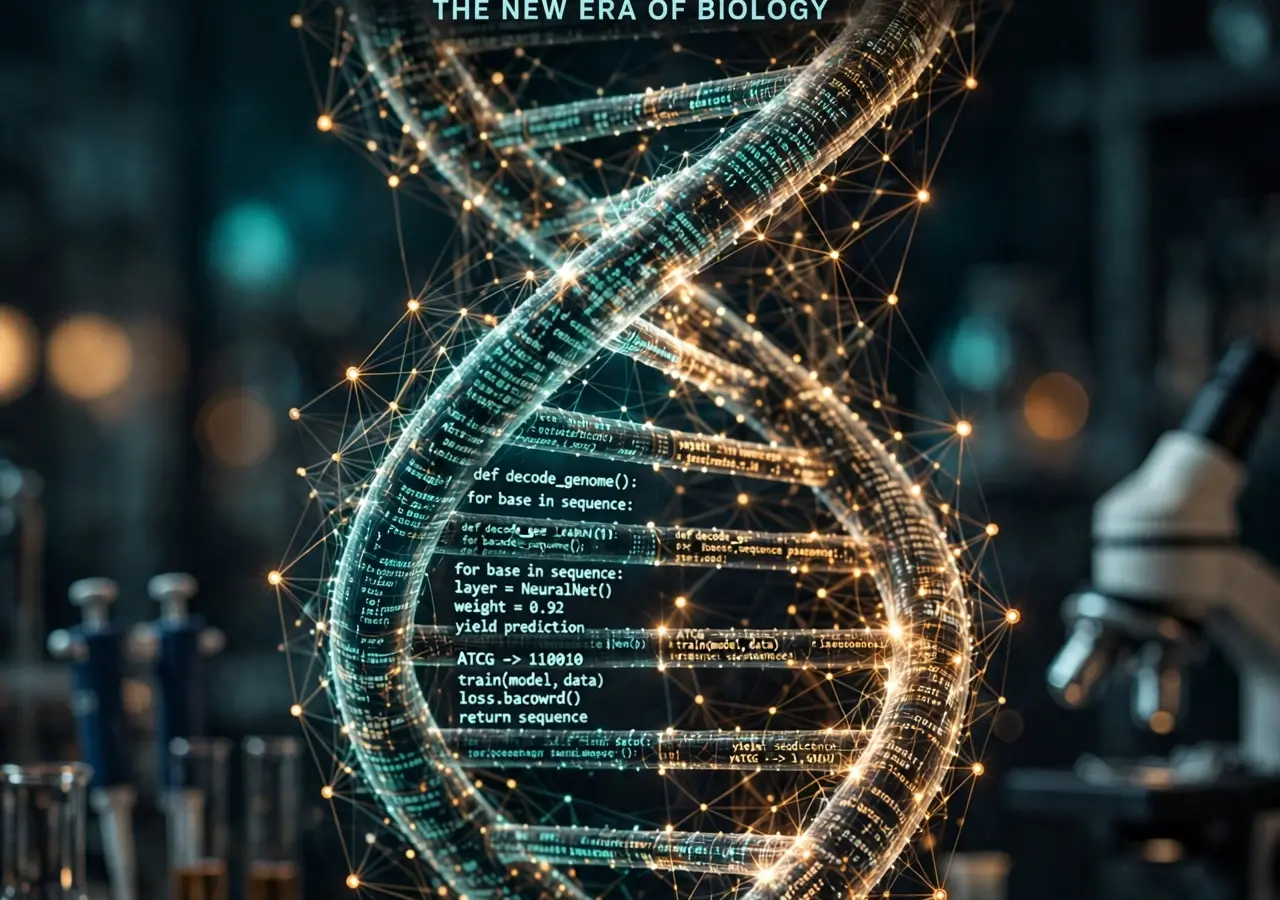
Biology has always had a source-code problem. The instructions are written in DNA, executed by proteins, and debugged — badly, slowly, at enormous expense — by us. For most of a century, reading that code meant decades of wet-lab work per protein, per pathway, per disease. In the last few years, something genuinely new has happened: machines have started reading the code faster than humans can write the questions. The honest question for an evidence-first reader is not whether AI is changing biology — it plainly is — but how much of the code is actually cracked, and how much is still handwriting we can’t read.
Exhibit One: Protein Structure, the Problem That Fell
The clearest proof of concept is protein structure prediction. A protein’s shape determines its function, and determining that shape experimentally — by crystallography or cryo-electron microscopy — used to take months to years per protein. DeepMind’s AlphaFold changed the unit of work: its predictions were accurate enough that the work was recognized with a share of the 2024 Nobel Prize in Chemistry, and the public AlphaFold Protein Structure Database now holds predicted structures for more than 200 million proteins, freely available to any researcher on earth.
Read that again with a skeptic’s eye, because it survives skepticism: a problem that consumed entire careers is now, for most single proteins, a lookup. But note what was cracked — the static shape of proteins, one frame of a movie. Proteins fold, flex, bind, and misbehave in motion, in crowds, inside cells. AlphaFold read the alphabet and much of the spelling. The grammar of how proteins behave in living systems is a harder text.
Exhibit Two: Generative Models Are Writing New Molecules
The second front is design rather than reading. Generative models now propose entirely new molecules — candidate drugs, enzymes, binders — shaped to order, which chemists then synthesize and test. The pipeline logic is compelling:
- Search space collapses. Instead of screening millions of physical compounds, researchers screen billions virtually and synthesize only the promising tail.
- Failure moves earlier. Candidates that would have died expensively in animal studies increasingly die cheaply in simulation.
- The loop tightens. Each round of lab results retrains the model, so the system compounds knowledge the way a good lab does — only faster.
The evidence discipline matters here: AI-designed candidates have entered human trials, which is real progress, but a candidate in a trial is a hypothesis, not a drug. The industry’s historical base rate — most candidates fail — applies to machine-written molecules too, until the data says otherwise.
Cancer is where much of this gets tested first, for a practical reason: oncology generates exactly the kind of structured molecular data these models eat — tumor genomes, protein targets, drug-response records — and it has no shortage of hard, well-defined problems. Matching a tumor’s mutations to the drug most likely to work, designing binders against targets once dismissed as undruggable, and predicting which patients will respond to which therapy are all, at bottom, reading-and-design problems. None of that is a cure, and this page will not pretend otherwise. It is, however, the arena where the gap between “AI reads biology” and “AI improves outcomes” will either close or be exposed — which makes oncology trial readouts some of the most informative data points in the field.
Exhibit Three: Cell-State Models, the Ambitious Bet
The frontier now is bigger than proteins or molecules: models that aim to predict the state of an entire cell — how it responds to a drug, a mutation, a disease. If protein prediction was reading words, cell-state modeling is trying to read the novel. The raw material is single-cell data, which has grown explosively, and the ambition is a kind of virtual cell: perturb it in software, watch what happens, and only then touch a real one.
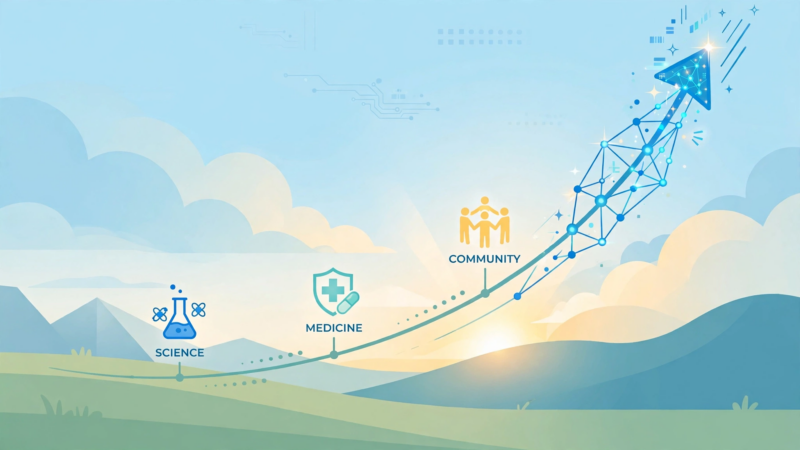
Cracking the code was never one problem. It is a staircase — structure, interaction, cell, tissue, patient — and we have climbed the first steps very fast and the rest barely at all.
What “Cracking the Code” Would Concretely Mean
Strip the metaphor down and a “cracked” biology would mean four capabilities, in ascending order of difficulty:
- Predict the structure and behavior of any biomolecule on demand — largely achieved for static protein structure, open for dynamics and complexes.
- Design molecules and proteins with specified functions that work first-try in the lab — emerging, with hit rates improving but not yet reliable.
- Simulate a cell’s response to a perturbation accurately enough to replace most screening experiments — early research stage.
- Translate all of it into therapies that survive human trials at a meaningfully higher rate than today’s — the only step patients experience, and the one with the least evidence so far.
The Bottlenecks Are Not Computational
Here is the part the hype cycle skips. The models are improving on a steep curve; the constraints are elsewhere:
- Data. Models learn from measurements, and biology’s measurements are noisy, batch-dependent, and concentrated in well-studied corners. The dark matter of biology — rare cell types, real patient diversity — is exactly where the data is thinnest.
- Validation. A prediction is cheap; proof is not. Every AI-proposed molecule still has to survive synthesis, assays, animal work, and human trials, and biology gets a vote at each stage.
- Wet-lab speed. The physical world iterates in weeks. Until automated labs close the loop at machine speed, the bottleneck is pipettes, not processors.
- Causality. Models are superb at correlation. Medicine runs on causation — change this, and the disease changes — and that gap is where confident predictions go to die.
A Realistic Timeline
So how soon do we crack the code? In layers. Protein-structure-level problems: already cracked, and the benefits are compounding quietly through every drug program that starts from a structure instead of a guess. Molecule design: plausibly routine within the decade, measured by rising trial success rates rather than press releases. Cell simulation: a research program for the 2030s, with useful partial models arriving sooner. The full stack — patient-level prediction as a standard of care — is a generation-scale project, not a product launch.
The verdict, in the evidence-journalism sense: the claim “AI is reading biology’s source code” is supported, with the correction that it has finished the first chapters, not the book. The claim “the code is cracked” is not yet supported — and the difference between those two sentences is where the next twenty years of medicine will happen. Watch the trial success rates. They are the only scoreboard that doesn’t accept hype as a deposit.
Conflicts of interest. None declared.
Not medical or investment advice. This article is general education. It cannot diagnose or recommend treatment for anyone, and company mentions are not recommendations to buy or sell securities. How we report and review.