Inspired by Matt Madigan’s video “1,000 Years of Tech Comes in the Next 10 Years?” (Oct 9, 2026). Watch the source video here: https://www.youtube.com/watch?v=ExqYRmqcu2o
Introduction
Most of us plan as if tomorrow will look a lot like today, only slightly better. Faster phones. Slightly smarter software. A few new tools at work.
Matt Madigan’s short video argues that this linear intuition is exactly what will mislead us. His central claim is simple and unsettling: AI progress is no longer creeping forward. It is accelerating, and the curve is bending upward so sharply that the next decade could contain a volume of change we would normally associate with a much longer stretch of history.
You do not have to accept every part of that argument to take it seriously. The useful question is not whether the timeline is exactly ten years. It is what we should do differently if even half of it is directionally right.
Why our gut gets exponentials wrong
Humans are good at straight lines and bad at curves that compound.
We tend to extrapolate from what we just experienced. If the last year felt like a modest upgrade, we assume the next year will feel the same. But a process that improves itself, and then uses that improved version to improve again, does not stay modest for long. Early on it looks unimpressive. Later, it looks sudden.
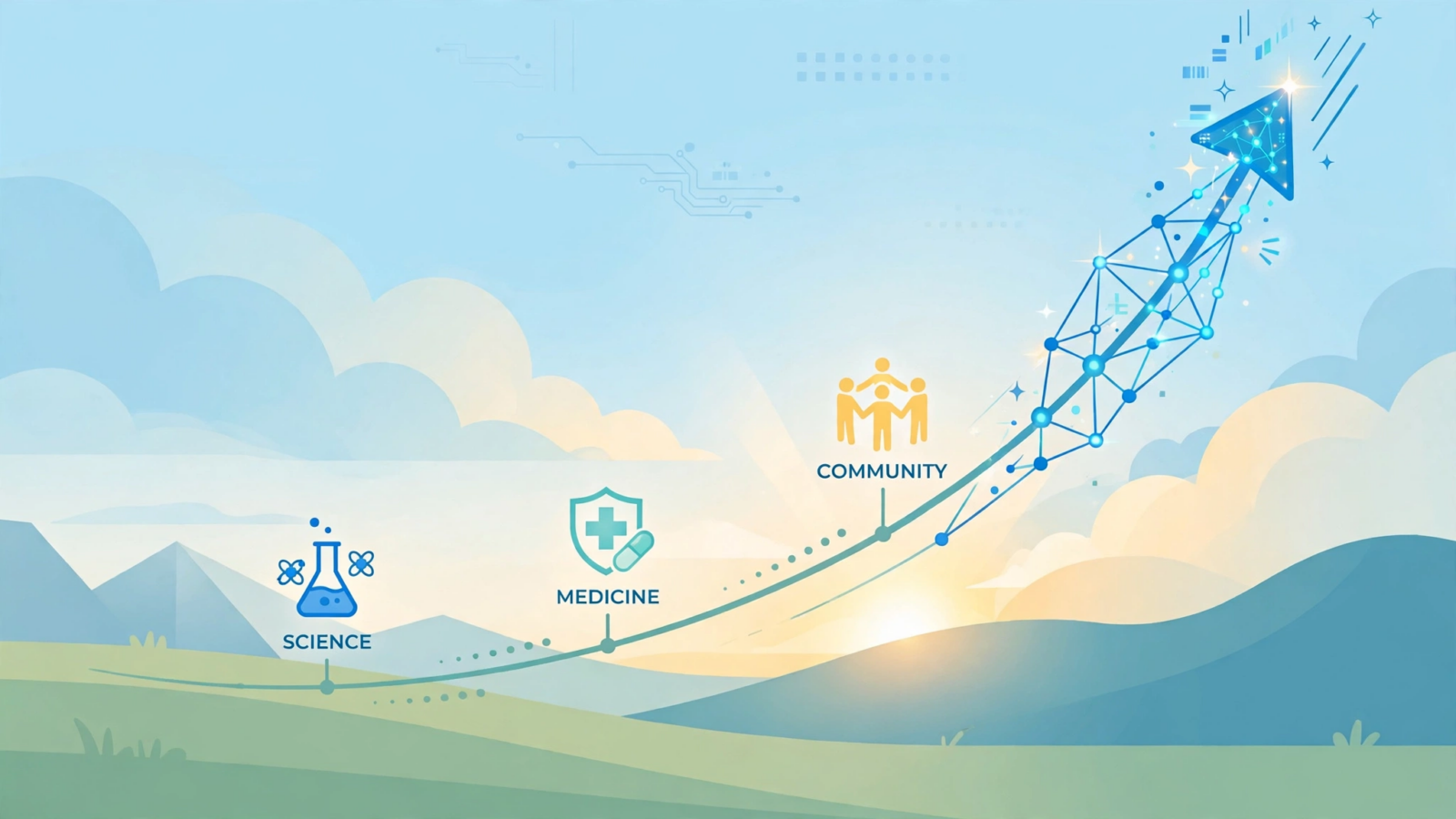
That is the video’s core image: a line that stays low for a long time, then turns sharply upward. By the time the change is obvious to everyone, most of the underlying shift has already happened in labs, in research papers, and in systems most people never see.
This is worth pausing on, because it explains a strange feeling many people have right now. AI feels both everywhere and strangely distant. We use it daily, yet the biggest breakthroughs still feel abstract. If Madigan is right, that gap is temporary. What is now confined to specialists will soon be ordinary, and what now feels like science fiction will start showing up as products, treatments, and job descriptions.
What is actually accelerating?
The video points to a pattern across fields, not just one chatbot getting better.
First, creative and technical work that once required a team is becoming something a small group, or even one person, can do with AI assistance. Coding, images, video, and music are the early examples.
Second, and more striking, is the move into fields that depend on deep reasoning and discovery. Mathematics and science are not just being automated at the edges. AI systems are increasingly able to help generate, test, and solve problems that once took specialists years.
Madigan’s explanation for why this is happening is a combination of forces, not a single trick: larger and more capable systems, better training methods, more computing power, and AI itself helping to build the next generation of AI. Each factor makes the others more powerful. That feedback loop, more than any single product launch, is why he argues superintelligence is a question of timing rather than possibility.
Whether you agree with that conclusion or not, the feedback-loop point matters. It means progress is less likely to plateau neatly just because one approach runs out of steam. When one bottleneck eases, another part of the system often picks up the slack.
Biology may be where it matters most
For most readers, the most consequential part of the argument is not about software. It is about biology.
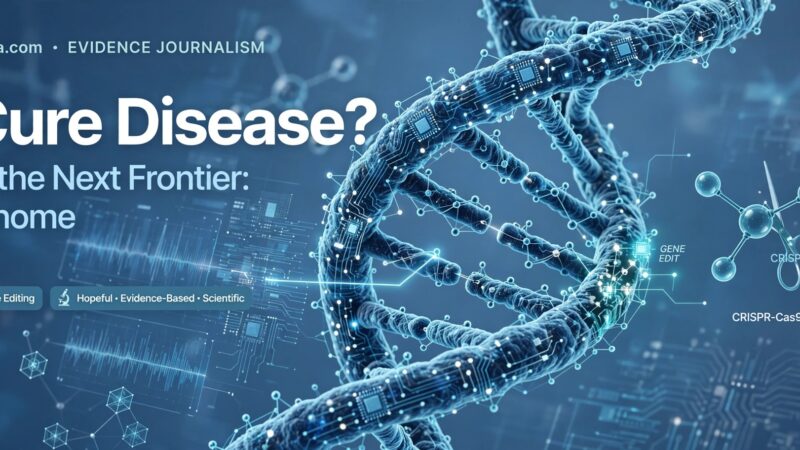
Madigan frames DNA as information: a code that can, in principle, be read, understood, and eventually rewritten. If AI becomes dramatically better at reading that code, then diseases and aging stop looking like inevitable fate and start looking like problems that can be investigated systematically.
That framing is powerful, but it needs care. Biology is messy, regulated, and slow to validate in the real world for good reasons. A promising result in a lab is not a safe treatment in a clinic. Cures require trials, safety data, manufacturing, and trust. Even a very capable AI cannot wish those steps away.
Still, the direction is worth watching. AI is already changing drug discovery, protein science, diagnostics, and medical research. The question for the next decade is how quickly those tools move from accelerating research to changing outcomes for patients — and who gets access first.
A helpful way to think about it: do not ask whether AI will cure everything. Ask which diseases, which diagnostics, and which preventive tools are most likely to improve first, and what that means for how we plan our health, our careers in healthcare, and our expectations for aging.
Work, purpose, and the tribe question
The part of the video that will divide readers most is its take on jobs.
Madigan does not pretend job disruption is painless. He argues, instead, that much of modern work already fails to give people what they actually want: engagement, belonging, and a sense of purpose that lasts. People invest years in a workplace community, change jobs, and lose that community overnight. That cycle, he suggests, is not how humans evolved to live.
His reframing is optimistic: if work stops being the organizing center of life, people could build lasting communities around chosen purpose rather than a paycheck. A tribe you choose, not a team you were assigned to.
That is an appealing vision, and also an incomplete one. Purpose is not automatic. Community takes effort. Income, identity, status, and daily structure all get tangled up in work, and removing work does not automatically replace them. A world with less traditional employment could be freer and more creative — or lonelier and more unequal — depending on the choices we make about income, education, social connection, and local community.
So the practical question is not whether jobs will change. They will. The question is what we build in parallel: skills that travel across jobs, relationships that do not depend on one employer, and projects that give us meaning whether or not they pay.
The risk argument, taken seriously
No honest version of this story can skip risk.
Madigan acknowledges that advanced AI carries real danger, and that safety work matters. His counterpoint is that inaction also carries a cost. Delaying medical and scientific progress, in his framing, means more people living with — and dying from — diseases we might otherwise learn to treat.
That tradeoff deserves serious discussion, not slogans from either side. It is not enough to say “slow down” without explaining what is lost by waiting, and it is not enough to say “speed up” without explaining how catastrophic risks are prevented, monitored, and contained.
A balanced reader should hold both ideas at once:
– Safety, oversight, and alignment are not optional extras. They are part of building technology this powerful.
– Caution is not cost-free. Every year of delay in medicine, clean energy, materials, and scientific discovery has human consequences too.
The debate we need is not optimism versus pessimism. It is: what safeguards make rapid progress responsible, and what progress is worth prioritizing first?
What to do with an idea like this
If you find the video persuasive, or even partly persuasive, here are grounded moves that make sense in either future — one where change is fast, and one where it is slower:
1. Learn to work with AI, not just about it.
Pick one workflow in your work or business and rebuild it with AI assistance. Document what improves, what breaks, and what still needs human judgment. That practical knowledge will age better than any prediction.
2. Build skills that compound.
Communication, judgment, teaching, building trust, and solving messy real-world problems are hard to automate fully. So is the ability to learn a new tool quickly and discard it when a better one arrives.
3. Invest in your tribe on purpose.
Do not wait for a future where work disappears to build community. Join, start, or deepen a group built around something you actually care about — a craft, a cause, a sport, a neighborhood, a learning circle. If the future is more fluid, those bonds will matter more, not less.
4. Watch biology, not just chatbots.
Follow credible medical and biotech developments separately from AI hype. The most life-changing breakthroughs may arrive quietly, as better diagnostics or treatments, rather than as a dramatic announcement.
5. Stay skeptical about timelines, open about direction.
Specific dates in tech predictions are almost always wrong. The direction — more capable systems, applied to more fields, faster — has been right more often than the skeptics expected. Plan for a range of speeds, not a single date.
The real takeaway
The video’s closing idea is not really about technology. It is about perspective.
We may be living at the start of a period that future generations will look back on as a turning point — not because everything is certain, but because so much is suddenly possible. That is both exciting and sobering. Extraordinary times do not guarantee extraordinary outcomes. They raise the stakes of the choices we make now.
So watch the video, enjoy the optimism, and then bring it back to earth: What will you learn? Who will you build with? What problem will you use these tools to solve?
The curve may or may not go vertical on schedule. But the people who are ready to learn, adapt, and build community will be in the best position either way — and that part is entirely in our hands.
Note: This is commentary on the video’s argument. Specific figures cited in the video are the creator’s claims and should be checked against primary sources before being repeated as fact.
Conflicts of interest. None declared.
Not medical or investment advice. This article is general education. It cannot diagnose or recommend treatment for anyone, and company mentions are not recommendations to buy or sell securities. How we report and review.