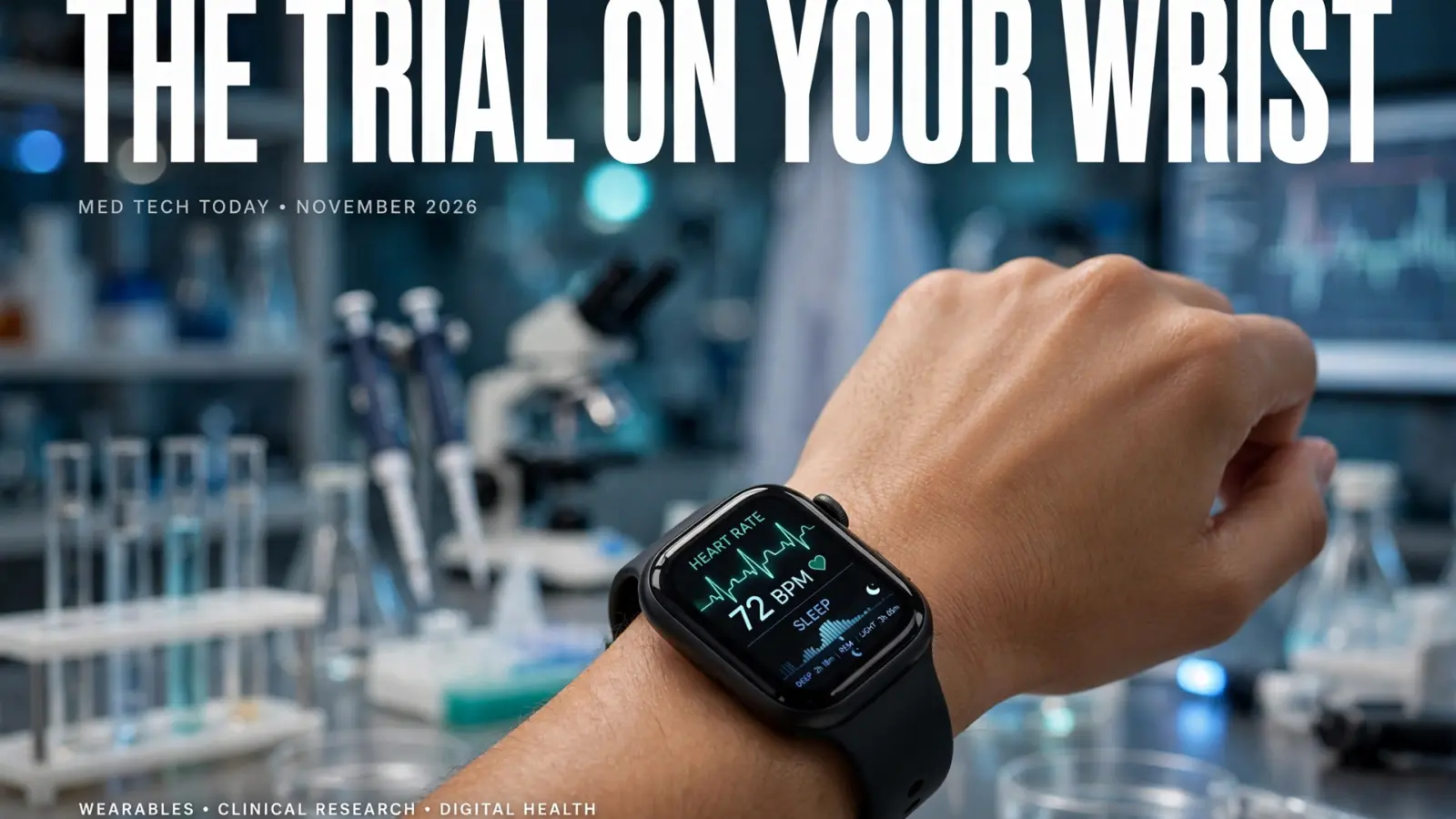
For most of modern drug development, the clinical trial has run on snapshots. A participant travels to a clinic, sits for a blood draw, walks a measured corridor, answers a questionnaire about the last two weeks — and that handful of staged moments becomes the evidence on which a drug is judged. The rest of the patient’s life, the 99% that happens outside the clinic, went largely unmeasured.
That is beginning to change. The same class of devices millions of people wear for fitness — wrist-worn activity trackers, smartwatches, sensor patches, continuous glucose monitors — is being recruited into clinical research, not as a gimmick but as a measurement instrument. The question facing drug developers is no longer whether wearable data can be collected during a trial. It is whether that data is good enough to prove a drug works.
The Snapshot Problem
The weaknesses of snapshot measurement are structural. A clinic visit captures a patient on one day, in an artificial setting, often on their best behavior. A person with a movement disorder may perform a walking test in a quiet hallway far better than they manage a crowded grocery store. Sleep is recalled in a questionnaire weeks after the fact. Symptoms that fluctuate — pain, fatigue, tremor, breathlessness — get flattened into a single score at a single visit.
Continuous sensing attacks exactly this problem. An accelerometer worn around the clock records how much a person actually moves, day and night, at home. Actigraphy — inferring sleep from movement patterns — can track sleep duration and fragmentation across weeks instead of relying on memory. Heart-rate and heart-rate-variability data accumulate passively. Continuous glucose monitors, long used in diabetes care, generate the kind of dense metabolic time-series that periodic blood tests cannot. None of this replaces clinical judgment. But it converts a trial’s evidence from a photo album into something closer to a film.
From Step Counts to Digital Endpoints
Collecting data is the easy part. The hard part — and the genuinely new science here — is turning a sensor stream into an endpoint: a defined, prespecified measure that a trial can be judged on, the way regulators have traditionally judged blood pressure or survival.
A digital endpoint is not “the watch recorded steps.” It is a carefully defined derivation: a specific measure, computed a specific way, over a specific window, shown to mean something clinically. Researchers have been developing such measures in areas where clinic snapshots are weakest — real-world walking and mobility in neurological conditions such as Parkinson’s disease, activity and sleep patterns in chronic disease, cardiac rhythm and activity in cardiology. The appeal is obvious: these measures can capture how a patient actually functions in daily life, which is, after all, what treatment is supposed to improve.
The catch is that a clever measure is not automatically a credible one. Which brings us to the regulators.
What Regulators Actually Require
Regulators have not waved wearables through. The U.S. Food and Drug Administration has published a formal guidance framework on digital health technologies for remote data acquisition in clinical investigations, and its central demand can be summarized in one phrase: fit for purpose.
In practice, that means a sponsor must show that the device measures what it claims to measure (verification), that the measurement is accurate and reliable in the population and setting where it will be used (validation), and that the resulting endpoint is meaningful — connected to how a patient feels, functions, or survives. The agency’s Digital Health Center of Excellence coordinates this work across the FDA, and sponsors are encouraged to engage regulators early rather than arriving at the end of a trial with a hard drive of sensor data and a hopeful argument.
This is a higher bar than the consumer market sets. A fitness tracker can be approximately right and still sell. A trial endpoint that is approximately right can sink a decade of development — or worse, approve a drug on evidence that doesn’t hold up.
The Real Advantages
Where wearables earn their place, the advantages are substantial:
- Recruitment and retention. Trials lose participants to burden — travel, time off work, repeated clinic visits. Remote, passive data collection lowers that burden, and decentralized designs can reach patients who live nowhere near a trial site.
- Sensitivity. Dense, continuous data can detect gradual change that sparse clinic visits would miss, and can do so with less noise from day-to-day variation.
- Real-world function. Endpoints built on everyday activity measure what patients care about — walking to the store, sleeping through the night — rather than performance in a corridor.
- Earlier signals. Continuous streams can reveal deterioration or response between scheduled visits, rather than months later.
The Hard Problems
Against those advantages sit problems the field has not solved, and honest coverage should name them.
Data quality. Consumer devices differ in accuracy, and algorithms that convert raw sensor signals into measures like “steps” or “sleep stages” are often proprietary black boxes. Two devices on the same wrist can tell different stories.
Device drift. Trials run for years; consumer hardware refreshes annually. A device discontinued mid-trial, or a firmware update that silently changes how a measure is computed, can contaminate a dataset in ways that are hard to detect and harder to repair.
Missing data and adherence. A wearable only measures when it’s worn and charged. Gaps are not random — people take devices off when they feel worst — and statisticians have to account for that bias rather than pretend the record is complete.
Equity. Research designs that assume participants own modern smartphones and wearables risk building trials — and eventually labels — around the population that already has the technology. Sponsors can supply devices, but connectivity, digital literacy, and comfort with surveillance still vary.
Privacy. A continuous sensor stream is intimate: location patterns, sleep, activity, physiology, around the clock. Consent, data ownership, and secondary use are not paperwork details; they go to whether participants can trust the enterprise at all.
What It Means for How Fast Drugs Prove Themselves
The stakes here are larger than gadgetry. Endpoint quality is one of the quiet bottlenecks of drug development: trials are long partly because the field measures outcomes rarely, coarsely, and late. If validated digital endpoints can measure meaningful change earlier and more precisely, some trials could be shorter, smaller, or more decisive — and some drugs that work in ways snapshots miss could be recognized instead of discarded.
That future is not here yet. Today, wearable-derived measures most often appear as exploratory or secondary endpoints — collected, analyzed, and used to build the validation case — while approval decisions still rest on conventional measures. That is the correct order of operations. The evidentiary standard is not an obstacle to the technology; it is what will make the technology’s evidence worth believing.
The trial on your wrist is coming. Whether it arrives quickly or slowly depends less on the sensors — those are already good and getting better — than on the unglamorous work of proving that what they measure deserves to decide the fate of a drug.
Conflicts of interest. None declared.
Not medical or investment advice. This article is general education. It cannot diagnose or recommend treatment for anyone, and company mentions are not recommendations to buy or sell securities. How we report and review.