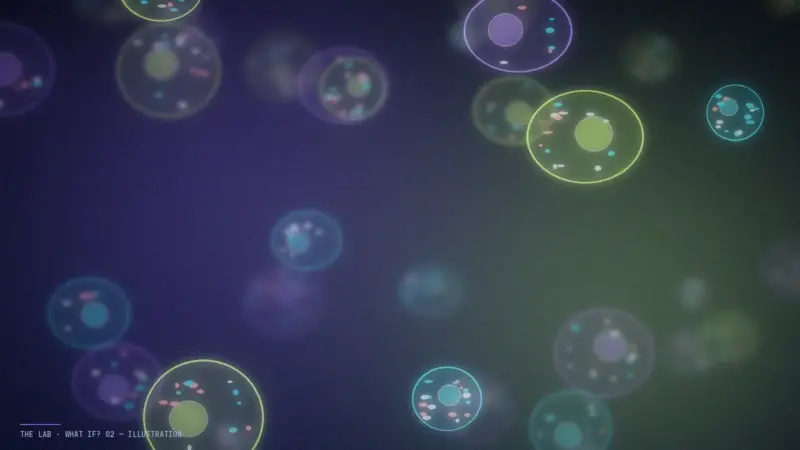
What if we could print living tissue that functions inside the body?
3D printers can already build objects layer by layer from plastic and metal. Bioprinting swaps the plastic for gels loaded with living cells. The dream is replacement tissue made to measure — but keeping printed cells alive and working inside a body is a formidable challenge.
⚠ This is a thought experiment. It explores a possibility; it does not report a result.

Original illustration — speculative and artistic, not a depiction of a real device, patient or result.
What exists today
Tissue engineering, the broader field, already has clinical uses, such as engineered skin substitutes for some wounds and burns. Bioprinting is younger. Researchers print cells within supportive gels, often called bioinks, to create small tissue structures for laboratory research, including models used to study disease and test drugs. Early human studies have tested bioprinted implants made from a patient's own cartilage-forming cells, for example to reconstruct an outer ear. These are relatively simple tissues. Printed solid organs such as kidneys, livers or hearts that could replace a failing organ remain a research goal, not a treatment.
What has been demonstrated
Labs have shown that bioprinters can position several cell types in precise patterns, and that printed tissues can survive and mature for a time in the lab. In animal studies, researchers have implanted printed constructs such as cartilage, bone and small tissue patches, and some have shown signs of integrating with surrounding tissue and developing blood supply. Scientists have also printed networks of tiny channels intended to mimic blood vessels. These results show the building blocks are possible. They do not yet show that a complex printed organ can be made reliably at human scale and function long-term inside a person.
What remains difficult
The central problem is blood supply. Cells need oxygen and nutrients within a short distance, so thick tissues need a dense, working network of vessels that connect to the body's circulation. Real organs also contain many cell types arranged in intricate structures that interact chemically and mechanically. Producing enough cells, keeping them alive during printing, and getting them to mature into adult-like tissue are all hard. Printed tissues must be sterile, consistent from batch to batch, and safe from the risk of cells growing abnormally. Regulators and surgeons would need ways to test quality before anything goes into a patient.
What would change if it worked
Functional printed tissue could ease reliance on donor organs, which are in short supply, and might reduce rejection if made from a patient's own cells. Surgeons could repair damaged cartilage, bone, skin or blood vessels with custom-shaped replacements. Even before transplantable organs, better printed human tissue models could improve drug testing and reduce some reliance on animal studies. The effects would likely arrive gradually, starting with simpler, thinner tissues and moving toward complex organs only if major scientific problems are solved. Cost, manufacturing scale and long-term safety monitoring would shape how widely any such treatment could be used.
What evidence would convince us
For any printed tissue intended for patients, convincing evidence would start with careful animal studies showing that the tissue survives, connects to blood supply and does its job for long periods without harm. Next would come small human trials focused on safety, then larger controlled trials comparing the printed tissue with the best existing treatment, such as donor grafts or standard surgery. Long-term follow-up would be essential, because problems may emerge years later. Independent replication, transparent reporting of failures, and consistent manufacturing across batches would all be signs that the technology is moving from impressive prototype to dependable therapy.
Which use of bioprinting do you think will reach patients first?
Polls measure reader opinion for fun and discussion. They are not scientific evidence.
If printed tissue could reduce the need for animal testing, how should we weigh that promise against how much we still do not know about it?
Try it hands-on:
Play Build a Cell →Related reporting
 DeepTech + MedTech
Bioprinting Human Tissue: What Works in the Lab, and What Would It Take to Reach Patients?
No bioprinted solid organ has been transplanted into a person, but bioprinting has produced striking lab and animal results. Here is what works today, what has reached early human testing, and what still stands in the way.
 DeepTech + MedTech
Organoids and Lab-Grown Models: Could They Improve How We Test Treatments?
Organoids and organ-on-a-chip systems let researchers test drugs on human tissue models before people. The early evidence is promising but specific, and the models still miss much of real human biology.
 Companies + Stocks
From University Lab to Startup: How Medical Discoveries Become Products
Most medical products begin as university research, then pass through tech transfer offices, licences or spinouts, and the regulatory system. This guide maps each step and the reasons discoveries stall.